
Attendance Allowance helps with extra costs if you have reached State Pension age and have a
long‑term physical or mental health condition that means you need help with personal care or supervision for safety.
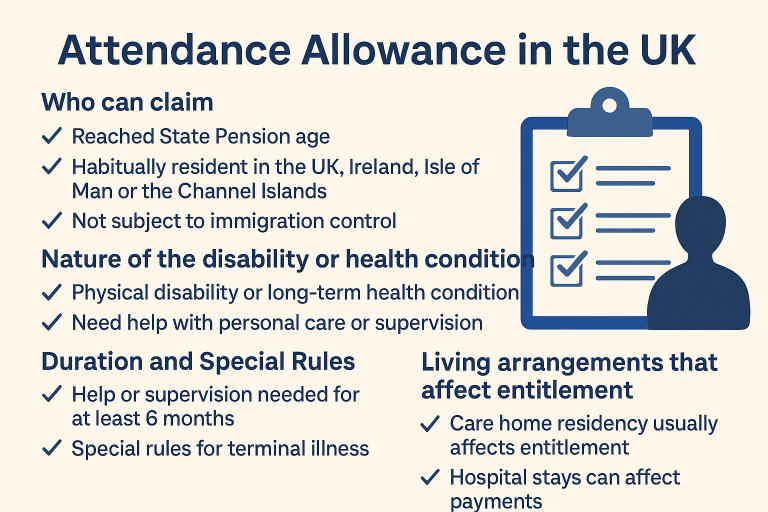
Who can claim
Age: You must have reached State Pension age when you claim; if you are below that age you may need to apply for Personal Independence Payment instead.
Residence and presence: You must be habitually resident in the UK, Ireland, Isle of Man or the Channel Islands and be in Great Britain when you claim, with some exceptions (for example certain members of the armed forces).
Immigration status: You must not be subject to immigration control in a way that prevents claiming public funds unless an exception applies.
Nature of the disability or health condition
Type of condition: Any physical disability (including sensory impairment) or mental disability (including learning
difficulties) or long‑term health condition can qualify; the specific diagnosis matters less than how the condition affects day‑to‑day life.
Needs assessed: Eligibility depends on whether your condition is severe enough that you need help with personal care or need someone to supervise you to keep you or others safe.
Duration and Special Rules
Minimum time: You must have needed that help or supervision for at least 6 months before you can be paid Attendance Allowance, except under the terminal illness rules.
Terminal illness: If you are terminally ill (normally expected to live 12 months or less) you may qualify more quickly
under the Special Rules and can be fast‑tracked, usually at the higher rate.
Living arrangements that affect entitlement
Care home residents: You usually cannot get Attendance Allowance if you live in a care home and the local authority is paying your care home fees; you can claim if you pay the care home costs yourself.
Hospital stays: Payments may be affected if you spend prolonged periods in hospital (for example more than 28 days); you must report changes in circumstances to DWP.
How entitlement is judged and what to include in a claim
Focus of assessment: The decision is based on the practical effect of your condition — what help you actually need with personal care tasks (washing, dressing, eating, moving around, managing medicines) and whether you need supervision to avoid danger to yourself or others.
Evidence to give: When you claim, describe in detail how your condition affects daily life, give dates and examples, and include supporting evidence from GP letters, hospital notes, care assessments, or statements from carers if available.
Assessments: You normally do not have a face‑to‑face medical assessment unless it is needed to clarify how your
condition affects you; if required you will be told in writing and why an assessment is necessary.
Other important points
Not means tested: Attendance Allowance is not affected by income or savings; your financial situation does not
determine eligibility.
Incompatible benefits: You cannot get Attendance Allowance at the same time as Disability Living Allowance, Personal Independence Payment, Adult Disability Payment or Armed Forces Independence Payment.
Scotland: If you live in Scotland you apply for the Pension Age Disability Payment rather than Attendance Allowance.
Practical next steps
Complete the official claim form AA1 (or AA1(SP) if claiming under Special Rules for terminal illness) and give clear, daily examples of the help or supervision needed and how often you need it.
Keep copies of medical letters and contact details for anyone who can corroborate daily care needs. Age UK has an
accessible factsheet that explains typical supporting evidence and practical tips for completing the form..